Why AP Automation Fails: 7 Costly Mistakes

Most organizations don’t invest in AP automation because they’re trying to eliminate paper. They invest because invoice approvals take too long, employees spend too much time searching for supporting documentation, and finance teams struggle to gain visibility into where work is getting stuck. As invoice volumes increase and compliance requirements become more demanding, those inefficiencies become increasingly difficult to ignore.

For many organizations, accounts payable automation appears to be the logical solution. Automating invoice capture, approval workflows, and document management promises greater efficiency, fewer manual tasks, and faster payment cycles. Yet implementing technology alone rarely solves process challenges.

Many organizations discover that invoices still sit in approval queues, employees continue searching multiple systems for purchase orders, contracts, or receiving documentation, and exceptions require manual follow-up. While paper may disappear, the inefficiencies that slowed the process often remain.

The difference between successful and unsuccessful AP automation initiatives isn’t the software itself. It’s how well organizations redesign the processes surrounding invoice approvals, document management, and workflow before introducing automation.

The seven mistakes below are among the most common reasons AP automation projects fail to deliver the operational improvements organizations expect. More importantly, they highlight the process improvements that consistently separate high-performing finance teams from those still struggling with inefficient, disconnected workflows.

1. Automating an Inefficient Process

Technology improves efficiency only when the underlying process is designed to support it.

Many organizations automate existing approval workflows without first evaluating whether those workflows still make sense. Over time, approval paths often become more complicated as departments grow, management structures change, and additional controls are introduced. Rather than simplifying the process, automation simply digitizes unnecessary steps.

Before implementing AP automation, organizations should evaluate how invoices move through the business, identify approval bottlenecks, eliminate redundant reviews, and establish consistent business rules. Streamlining the process first allows automation to reinforce efficiency rather than preserve inefficiency.

This often happens because organizations focus on replacing paper rather than evaluating how work actually moves through the business. Existing approval paths, routing rules, and manual workarounds are recreated within the new system without questioning whether they still serve a purpose. While the technology changes, the underlying process remains largely unchanged.

2. Documents Remain Disconnected

Invoices rarely tell the complete story. Approvers often need purchase orders, contracts, receiving documentation, vendor correspondence, or previous approval history before making a payment decision. When those documents exist across shared drives, email inboxes, filing cabinets, or multiple business applications, employees spend valuable time searching instead of approving.

Connecting documents directly to ERP transactions and approval workflows provides the context needed to make faster, more informed decisions while reducing delays caused by missing information.

3. Exception Handling Is Still Manual

Every AP department manages invoice exceptions.

Pricing discrepancies, missing purchase orders, duplicate invoices, partial shipments, and vendor questions are part of normal business operations.

Many automation projects perform well when invoices follow the expected path but rely on email and spreadsheets whenever exceptions occur. As a result, visibility declines, ownership becomes unclear, and invoices remain unresolved longer than necessary.

Effective accounts payable automation includes structured exception workflows that automatically assign tasks, notify stakeholders, capture supporting documentation, and maintain a complete activity history until issues are resolved.

Collaborative Invoice Workflow Meeting

4. Approval Workflows Don't Match the Business

Not every invoice should follow the same approval path.

A routine office supply purchase shouldn’t require the same level of review as a major capital investment. Yet many organizations create one workflow for every invoice, adding unnecessary approval steps that slow processing without improving financial control.

Modern invoice approval workflows should use configurable business rules based on factors such as invoice amount, department, vendor, cost center, or purchase order status. This approach maintains governance while reducing unnecessary delays.

5. Limited Visibility Prevents Continuous Improvement

One of the most valuable benefits of AP automation extends well beyond faster invoice processing. It provides organizations with the visibility needed to understand how work moves through the accounts payable process and where opportunities for improvement exist.

Many finance teams can easily determine whether an invoice has been received or paid. What is often more difficult to answer are the operational questions that affect efficiency every day.

Where are invoices spending the most time?

Which departments consistently create approval delays?

How many invoices require exception handling?

Which vendors generate the highest number of discrepancies?

How long does it typically take to move an invoice from receipt to payment?

Without this level of insight, process improvement becomes largely reactive. Finance teams recognize problems only after payment deadlines are missed, vendors begin following up on outstanding invoices, or month-end close takes longer than expected.

Visibility changes that dynamic.

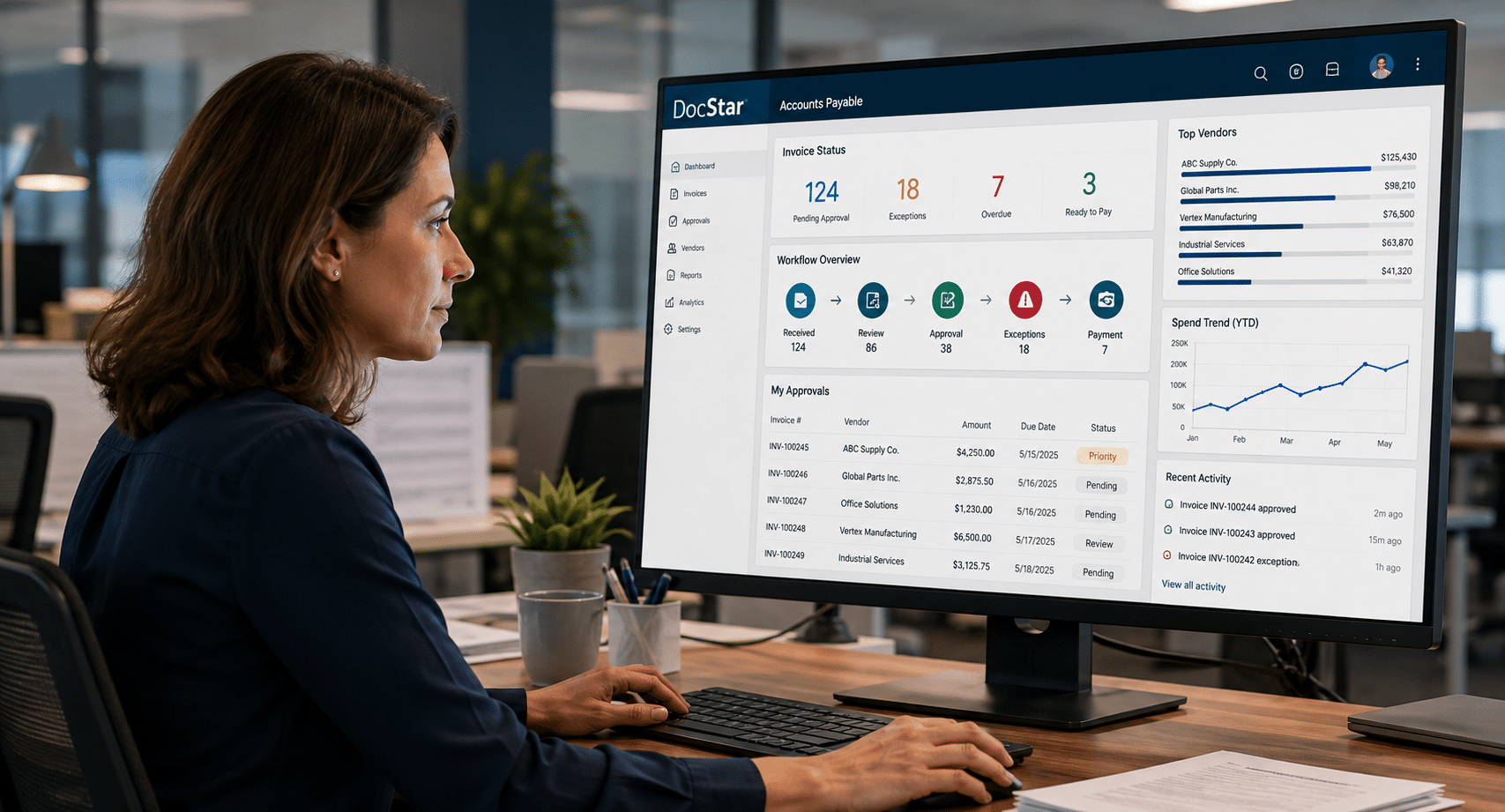
Workflow dashboards, reporting, and process analytics provide finance leaders with the information needed to identify bottlenecks before they become larger operational issues. Rather than relying on assumptions or anecdotal feedback, organizations can make informed decisions based on measurable workflow performance.

For example, reporting may reveal that invoices consistently remain with a particular approval group longer than expected, or that a specific vendor generates a disproportionate number of exceptions due to incomplete documentation. These insights allow organizations to address the root cause of delays rather than simply responding to their symptoms.

Perhaps most importantly, visibility supports continuous improvement. As business priorities evolve, organizations can evaluate workflow performance, measure the impact of process changes, and refine approval rules based on objective data rather than intuition. This transforms accounts payable automation from a tool that processes invoices into a platform that helps finance teams continuously improve operational performance.

Organizations cannot improve what they cannot measure. Visibility provides the foundation for identifying inefficiencies, measuring progress, and ensuring that AP automation continues to deliver value long after implementation.


6. Success Is Measured by the Wrong Metrics

Many organizations measure the number of invoices scanned or processed electronically.

While those metrics demonstrate adoption, they don’t necessarily indicate success.

More meaningful measures include approval cycle time, cost per invoice, exception rates, early payment discounts captured, and invoices paid on time. These metrics better reflect whether AP automation is improving operational performance and delivering measurable business value.

7. Automation Isn't Continuously Improved

Successful organizations recognize that AP automation is about more than processing invoices faster. They focus on creating connected, transparent workflows that provide employees with the information they need to make timely decisions.

High-performing finance teams simplify approval processes before automating them, connect supporting documents with ERP transactions, manage exceptions within structured workflows, and use reporting to identify opportunities for continuous improvement. They also measure success using operational outcomes rather than implementation statistics, ensuring automation continues to evolve alongside the business.

The result is a process that improves efficiency, strengthens compliance, and gives finance leaders greater visibility into how work moves across the organization.

What High-Performing AP Organizations Do Differently

High-performing finance organizations understand that AP automation is about more than accelerating invoice processing. They recognize that long-term success depends on creating a connected process where people, documents, workflows, and business systems work together to support faster, more informed decision-making.

Rather than simply replacing manual tasks with digital ones, these organizations focus on continuously improving how work moves through the accounts payable process. They simplify approval workflows before automating them, ensure supporting documents are readily available throughout the approval process, and manage exceptions within structured workflows that maintain visibility and accountability from receipt through payment.

They also measure success using meaningful business outcomes rather than implementation milestones. Metrics such as approval cycle time, exception rates, invoice aging, and workflow bottlenecks provide valuable insight into process performance and identify opportunities for ongoing improvement.

While every organization has unique operational requirements, successful AP teams typically share several best practices:

  • Simplify workflows before automating them to eliminate unnecessary approvals and manual handoffs.
  • Connect invoices with supporting documents and ERP transactions so employees have immediate access to the information needed to make informed decisions.
  • Manage exceptions within structured workflows rather than relying on email, spreadsheets, or informal follow-up.
  • Use reporting and workflow analytics to identify bottlenecks, monitor performance, and support continuous process improvement.
  • Regularly review and refine approval rules to ensure workflows continue to align with changing business needs, organizational structures, and compliance requirements.

Organizations that consistently follow these principles are better positioned to reduce processing times, strengthen financial controls, improve audit readiness, and create an accounts payable process that scales as the business grows.

Conclusion

Successful AP automation isn’t defined by how many invoices are digitized or how quickly software is implemented. Its success is measured by how efficiently information moves through the organization, how easily employees can access the documents they need, and how effectively finance teams can manage approvals, exceptions, and compliance.

Organizations that achieve the greatest return from AP automation recognize that technology is only one part of the equation. They simplify workflows before automating them, connect documents with ERP transactions, establish meaningful performance metrics, and continuously refine their processes as business needs evolve. The result is faster invoice processing, greater operational visibility, stronger financial controls, and a more efficient accounts payable function.

Ultimately, the most successful AP automation initiatives don’t just replace paper with digital documents—they improve the way work flows across the organization. When employees have immediate access to the information they need, decisions are made faster, bottlenecks become easier to identify, and finance teams can spend less time managing administrative tasks and more time delivering strategic value to the business.

Modernize Accounts Payable with Epicor DocStar

Most organizations don’t invest in AP automation because they’re trying to eliminate paper. They invest because invoice approvals take too long, employees spend too much time searching for supporting documentation, and finance teams struggle to gain visibility into where work is getting stuck. As invoice volumes increase and compliance requirements become more demanding, those inefficiencies become increasingly difficult to ignore.

For many organizations, accounts payable automation appears to be the logical solution. Automating invoice capture, approval workflows, and document management promises greater efficiency, fewer manual tasks, and faster payment cycles. Yet implementing technology alone rarely solves process challenges.

Many organizations discover that invoices still sit in approval queues, employees continue searching multiple systems for purchase orders, contracts, or receiving documentation, and exceptions require manual follow-up. While paper may disappear, the inefficiencies that slowed the process often remain.

The difference between successful and unsuccessful AP automation initiatives isn’t the software itself. It’s how well organizations redesign the processes surrounding invoice approvals, document management, and workflow before introducing automation.

The seven mistakes above are among the most common reasons AP automation projects fail to deliver the operational improvements organizations expect. More importantly, they illustrate the practices that distinguish high-performing finance teams from those still struggling with inefficient, disconnected workflows.

Learn how Epicor DocStar can help transform your
accounts payable process.

Schedule a Conversation

Related Articles